Speak to an Expert
admin@eumediation.net
Train to be an IMI-Accredited Mediator with the five-day, face-to-face Interpersonal Mediation Practitioner’s Certificate (IMPC), Europe’s market-leading Level Four mediator qualification.
You will qualify to mediate and resolve interpersonal disputes in workplaces, neighbourhoods, landlord-tenant situations, with families at risk of breakdown, in medical settings, and in complaint scenarios.
You will also gain an in-depth understanding of the psychology of conflict: why we come into conflict, why it is so hard to navigate our way out of it, and how an impartial mediator can help people in dispute to finally achieve transformative resolution.

Leads to 'Accredited Interpersonal Mediator' status
Europe’s only Level 4 mediation course
Learn to resolve all types of interpersonal disputes
Recognised by the International Mediation Institute (IMI)

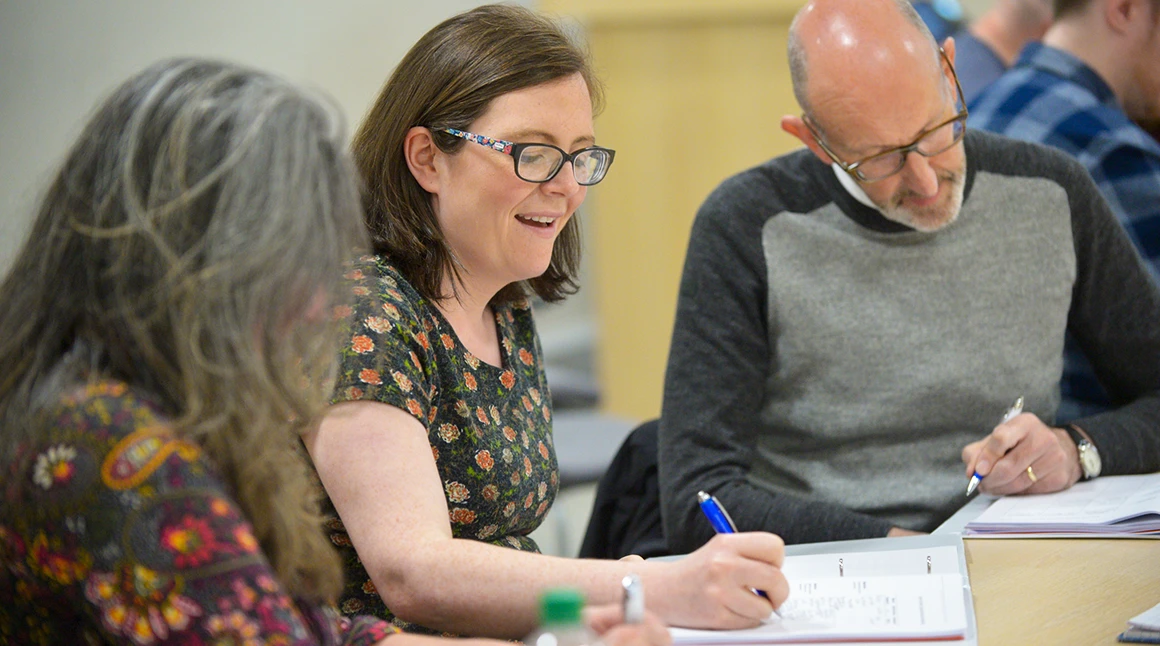
All of our trainers are practising mediators with many years of experience. They are also certified adult educators, meaning you’re in capable hands during your training!

We ensure that our courses are held in only the best venues in major European cities. All of our locations have fantastic catering, great transport links, and plenty of hotel choices nearby.

Our training course sits on Ofqual’s framework, the official regulator of examinations. It is recognised at Level 4 - the highest mediator qualification available in Europe.

The IMPC is a Recognised Mediator Training Program (RMTP) with the International Mediation Institute (IMI). This means that your training meets globally-recognised standards.

ISO 9001 is the internationally-recognised standard for quality management. You can be sure that all of our training will be carried out in an efficient and quality-focused manner.

All successful delegates will receive exclusive access to our online IMPC Learner Zone, a hub of useful information, tools, and resources for qualified mediators.
The aim of this five-day course is to get you to the point of being confident and competent to practise all types of interpersonal mediation, and to get you to the point of IMI-Accredited Mediator status.
At the conclusion of the course, you will be able to:
Understand the underpinning principles of interpersonal mediation
How mediation compares with other forms of dispute resolution. Why and how mediation works: putting people and their needs at the heart of the process.
Understand how people's behaviours can impact upon conflict
What makes people behave the way they do when they are in conflict and how this will influence what we do as mediators. Getting people’s buy-in.
Understand the structure of the mediation process
The steps and stages of our structured mediation model, and the purpose and structure of each stage. What can go wrong and dealing with the unexpected.
Understand the particular role of the mediator
The mediator’s role, how this differs from other roles, and the importance of impartiality and confidentiality. Where mediation fits in with other processes.
Understand the skills required for effective relational repair
You will mediate simulated cases alongside fellow learners and receive detailed feedback. Having a go at one of our specially-chosen case examples.
Reflect upon your practice and consider your own development
Your strengths and areas for improvement as mediators, and how you will specifically apply your new skills and knowledge in the future.
The Interpersonal Mediation Practitioner's Certificate covers everything you need to know to become a professional mediator.
This includes:
The psychology of conflict
What makes people behave the way they do when in conflict and how this will influence what we do as mediators.
The principles of transformative interpersonal mediation
How mediation compares with other ways of resolving disputes and how to choose what sorts of situations should be mediated. How and why mediation repairs relationships.
Managing the mediation process
The steps and stages of our structured seven-stage mediation model and the purpose of each stage. Dealing with resistance, disruption, and unexpected obstacles during the mediation sessions.
Key mediation skills
Practising on simulated cases and receiving live feedback from your tutor. Learning key skills such as reframing, reflection, and active listening.
Diversity competence
Acknowledging that diversity of some sort exists among all participants and that only through acknowledgement can we achieve the best kind of resolution.
Taking your practice forward
Your strengths and areas for improvement, and factoring these into a personal development plan. Conforming to best practice and adhering to UK Mediation’s Code of Conduct.
Our trainers have a wealth of practical mediation experience and are able to adapt the course content to the make-up of the particular group.
A number of bodies and organisations accredit, register, validate, and in various ways rubber-stamp the activities of wide range of mediators. We can understand if you would find it a bit confusing!
Let us explain:
This course is in Interpersonal Mediation. It is not meant for those wishing to work purely in commercial mediation, negotiating financial and contractual matters; neither is it intended for family mediators who work with divorce and separation. It is the only course you need if you want to resolve disputes between people whose relationship needs to be repaired.
The course is a 'Recognised Mediator Training Programme' (RMTP) with the International Mediation Institute (IMI). When you have achieved on the course, you can apply to be listed as an ‘IMI Qualified Mediator’ and be recognised as having completed a high-quality mediation course that meets international quality standards.
Different accrediting bodies are more concerned with commercial or family mediation, and usually require 60 hours or more tuition, spread out over a period of weeks. This course is more about people: how they get into conflict, what happens at a psychological level when they get stuck there, and how a mediator can help them to move on. It is a five-day, 40-hour course; only delivered face-to-face, led by a highly experienced mediator, and internationally recognised.
All of our courses are live, interactive events, run by a practising mediator who is an expert in the field.
We use a range of methods to deliver the course, including:
Video of a simulated dispute
Lecture and discussion
Group exercises
Small-group activities
Practice sessions with simulated case material
Real-life case studies
The course is delivered face-to-face at one of our training venues, where we can use custom-made video material, carry out discussions, run small group exercises, and have some practice sessions.




Dublin - 1st-5th February 2027
Central Dublin Venue

We understand that you may have some queries about the course’s content, the resulting qualification, or about how the training is delivered. We’ve gathered together some of the most Frequently Asked Questions and have answered them below.
Please get in touch if you have any questions we might have missed and one of our experts will be more than happy to help.
Watch a recent webinar from our sister organisation, UK Mediation, on how you can become a professional interpersonal mediator, either as part of an organisation or as a freelance practitioner.


We’re a friendly bunch here at EU Mediation and we’re always happy to discuss your requirements.
admin@eumediation.netWe’re a friendly bunch here at EU Mediation and we’re always happy to discuss your situation and offer impartial advice.
admin@eumediation.net